Aviation Terms
| Title | Description |
| C | Charlie |
| C Check | Aircraft maintenance check performed approximately every 12–18 months or a specific amount of actual Flight Hours(FH) as defined by the manufacturer. This maintenance check puts the aircraft out of service and requires plenty of space - usually at a hangar at a maintenance base. The schedule of occurrence has many factors and components as has been described, and thus varies by aircraft category and type. |
| CAASA | Business Aviation Division of Commercial Aviation Association of Southern Africa |
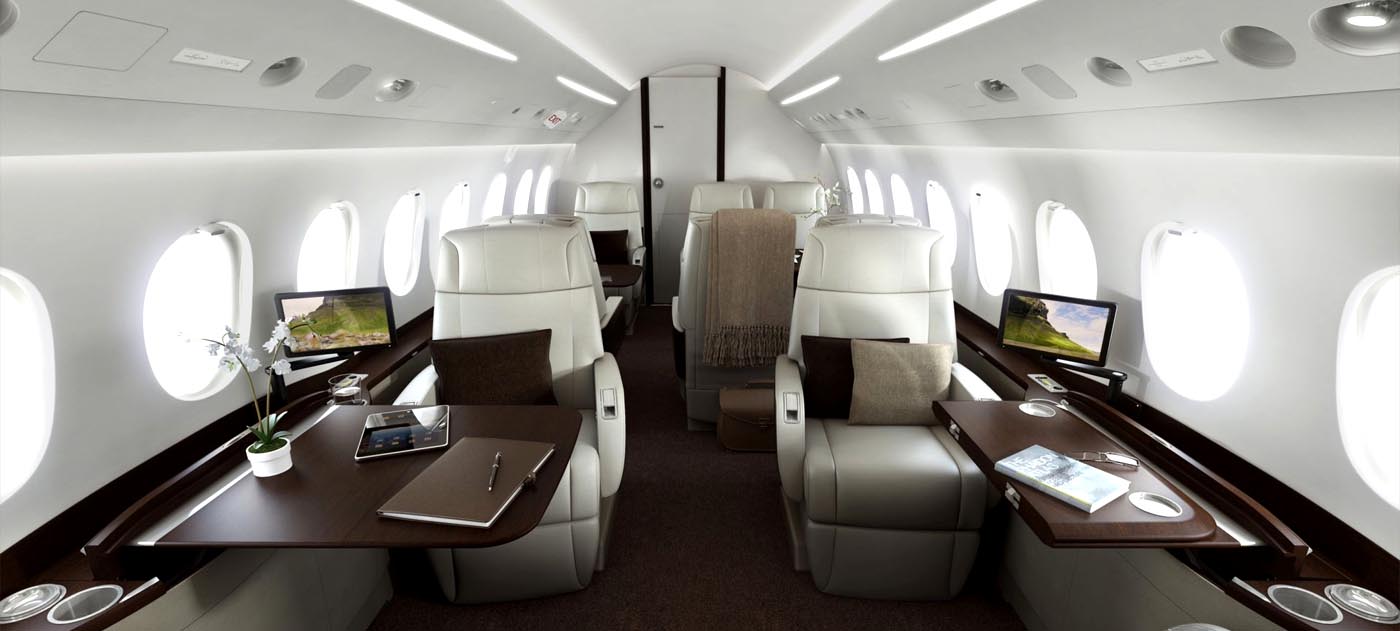
| Cabin | The enclosed section of an aircraft used for the crew, passenger seating, or cargo. |
| Cabin Height | Height of the jet cabin. Typically ranges from 4.2 feet to 7.3 feet. |
| Cabin Length | Length of the jet cabin. Typically ranges from 7.6 feet to 107.3 feet. |
| Cabin Width | Width of the jet cabin. Typically ranges from 4.5 feet to 12.2 feet. |
| Cabotage | The exclusive right of a country to operate air traffic within its territory. The transport of goods or passengers between two points in the same country. |
| Calibrated Air Speed | CAS. The speed shown by a conventional airspeed indicator after correction for instrument error and position error. |
| CALP | Civilian Aircraft Landing Permit |
| Camber | The curved upper surface of the wing. |
| Captain Seats | Oversized seats usually found in heavier private jets. |
| Carbon Credit | A permit that allows the holder to emit one ton of carbon dioxide. Credits are awarded to countries or groups that have reduced their green house gases below their emission quota. The carbon credit system was ratified in conjunction with the Kyoto Protocol. Its goal is to stop the increase of carbon dioxide emissions. |
| Carbon Footprint | The total set of greenhouse gases (GHG) emissions caused by an organization, event or product. It is often expressed in terms of the amount of carbon dioxide, or its equivalent of other GHGs, emitted. |
| Carbon Offset | A financial instrument aimed at a reduction in greenhouse gas emissions. Carbon offsets are measured in metric tons of carbon dioxide-equivalent and may represent six primary categories of greenhouse gases. One carbon offset represents the reduction of one metric ton of carbon dioxide or its equivalent in other greenhouse gases. |
| Cardinal Altitude | Thousand foot flight levels or altitudes. |
| Cargo Airliner | Aircraft used to transport large amounts of goods and products. Not certified for passenger loads. |
| Cargo Hull | Area of an aircraft in which cargo is loaded for transport. |
| Catering | A value added service offered by most jet operators and charter brokers. No request should be too big or small when the flyer requests certain meals, drinks, or extra services. |
| CBAA | Canadian Business Aircraft Association |
| Center of Gravity (CG) | The point at which the mass of the aircraft is balanced. This changes depending on the loading of the aircraft: fuel, passengers, luggage, etc. Different aircraft have CG limits specified by their manufacturer. If the CG of the aircraft in its current configuration is outside of the specified limits, the aircraft may be unsafe to fly. For example, if the CG is behind the aft (rear) CG limit, the aircraft will tend to stall. |
| Certificate of Airworthiness | A document issued by an aviation authority stating that an aircraft meets specific safety and performance requirements that allow it to be used in service. |
| Charter Broker | Entities, companies and individuals, that link prospective charter customers with charter operators. An air charter broker matches a consumer’s travel needs with available air charter provided by carriers licensed under Part 135 of the Federal Aviation Regulations (FARs). Find listings of Jet Charter Brokers. |
| Charter on Demand | Rental of a jet aircraft or helicopter one trip at a time. These trips can be one-ways, round trips, or multi-leg flights. Find aircraft available for Charter on Demand flights on the Empty Legs or Transient Aircraft pages of JetRequest.com. |
| Charter Operator | A company or individual that holds aircraft charter certificates and provides charter services to retail and wholesale customers. Request a jet directly from a Charter Operator on the Empty Legs and Transient Aircraft pages of JetRequest.com. |
| Chock | A metal or wooden block or wedge placed under the wheels of an aircraft to keep it from rolling. |
| Chock Off | When an aircraft no longer has the chocks wedged under the wheels. |
| Chock On | When an aircraft has the chocks placed under the wheels to prevent it from moving. |
| Chord | The dimension of a wing parallel to the direction of motion. (Compare with span and thickness.) |
| Civil Aviation | One of two major categories of flying, representing all non-military aviation, both private and commercial. Civil aviation includes two major categories: Scheduled Air Transport and General Aviation. |
| Class A Airspace | Controlled airspace in which all operations must be conducted under Instrument Flight Rules (IFR) or Special Visual Flight Rules (SVFR) and are subject to ATC clearance. All flights are separated from each other by ATC. |
| Class B Airspace | Contolled airspace in which operations may be conducted under IFR, SVFR, or Visual Flight Rules (VFR). All aircraft are subject to ATC clearance. All flights are separated from each other by ATC. |
| Class C Airspace | Controlled airspace in which operations may be conducted under IFR, SVFR, or VFR. All flights are subject to ATC clearance. Aircraft operating under IFR and SVFR are separated from each other and from flights operating under VFR. Flights operating under VFR are given traffic information in respect of other VFR flights. |
| Class D Airspace | Controlled airpspace in which operations may be conducted under IFR, SVFR, or VFR. All flights are subject to ATC clearance. Aircraft operating under IFR and SVFR are separated from each other, and are given traffic information in respect of VFR flights. Flights operating under VFR are given traffic information in respect of all other flights. |
| Class E Airspace | Controlled airspace in which operations may be conducted under IFR, SVFR, or VFR. Aircraft operating under IFR and SVFR are separated from each other, and are subject to ATC clearance. Flights under VFR are not subject to ATC clearance. As far as is practical, traffic information is given to all flights in respect of VFR flights. |
| Class F Airspace | Uncontrolled airspace in which operations may be conducted under IFR or VFR. ATC separation will be provided, so far as practical, to aircraft operating under IFR. Traffic Information may be given as far as is practical in respect of other flights. |
| Class G Airspace | Uncontrolled airspace not designated as Class A, B, C, D, E, or F. Operations may be conducted under IFR or VFR. ATC separation is not provided. Traffic Information may be given as far as is practical in respect of other flights. |
| Clearance | Permission given by Air Traffic Control for an aircraft to proceed under certain conditions contained within the clearance. |
| Club Seats | Oversized seat usually found in a private aircraft. |
| Co-Pilot | A pilot designated to be second in command of an aircraft during flight. He will relieve the pilot if necessary. Also referred to as second-in-command. |
| Cockpit | The area of an airplane or helicopter where the pilot and crew control the aircraft. |
| Commercial Aviation | The part of civil aviation (both general aviation and scheduled airline service) that involves operating aircraft for hire to transport passengers or cargo. It is the purpose of the flight, not the type of aircraft or pilot, that determines whether the flight is commercial. For example, a two-seat Cessna 150 towing a banner for money would be a commercial flight, while a large jet flown by its owners for a private vacation would not be, even if the pilots were commercially certificated and the jet was commercially registered. |
| Concierge | Most jet operators and charter brokers serve as a concierge for their clients and should be able to handle any request from a client. A concierge is a person who assists clients with various tasks like making restaurant reservations, arranging for spa services, recommending nightclubs, booking transportation (limousines, airplanes, boats, etc.), procurement of tickets to special events and assisting with various travel arrangements and access to local attractions. |
| Control Surface | Any moveable surface on an aircraft which controls its motion about one of the three principal axes. Ailerons, elevators, and the rudder are examples of control surfaces. In addition, other type of roll control surfaces are roll spoilers that dump lift on one wing or another (as opposed to ailerons), spoilerons (combined spoiler and aileron), and flaperon (combined flap and aileron). Another combined controls is the ruddervator (combined elevator and rudder). Other subsidiary controls are pitch, roll, and rudder trim tabs and the stabilator (the whole horizontal stabilizer moves to trim the pitch axis). |
| Controlled Airspace | Aviation term used to describe airspace in which ATC has the authority to control air traffic, the level of which varies with the different classes of airspace. Controlled airspace is established mainly for three different reasons: 1- high-volume air traffic areas (e.g. near airports), 2- IFR traffic under ATC guidance, 3- security. According to the airspace classes set by ICAO, Class A, B, C, D, and E airspace are controlled. It is the opposite of uncontrolled airspace. |
| Corporate Jet | A private jet utilized by a company or executive for use on corporate and business related trips. Find corporate jets available for charter flights on the Empty Legs and Transient Aircraft pages of JetRequest.com. |
| Corporate Jet Charter | A private jet chartered by a company or executive for use on corporate and business related trips. Find aircraft available for Corporate Jet Charter flights on the Empty Legs and Transient Aircraft pages of JetRequest.com. |
| Course | The direction in which the aircraft is moving, not to be confused with the heading which is the direction the aircraft is pointing. The course and heading will usually differ because of crosswinds (see crab). The course is also different from the track which is properly the path over the ground that the aircraft has already flown (although course and track are sometimes used synonymously). |
| Crab | A maneuver in which an aircraft is steered slightly into a crosswind to compensate for flying slightly off course. |
| Crew Expenses | The costs incurred by the crew when away from home base for accommodations, transportation, and meals. |
| Crosswind | A surface wind that is blowing across the runway making landings and takeoffs more difficult than if the wind were blowing straight down the runway. |
| Cruise Speed | Cruise speed is the normal speed attained at altitude once the aircraft is no longer climbing and is en route. |
| Cruising Altitude | A level altitude maintained by an aircraft while in flight. |
| Cycle | One takeoff and landing of an aircraft is referred to as one cycle. This is one measurable used to calculate the "newness" or the "wear and tear" of an aircraft. Along with flight hours, used to determine appropriate timing for maintenance checks. |